New to Travel Points? Here Is Where to Start, Step by Step
You see people flying on points and think they are hard to get. Here is where to start, from zero: one card bonus, Rakuten, Rove, then how to spend them.
By Vamsi, RewardsGuru.club. Published November 8, 2026.
As an Amazon Associate I earn from qualifying purchases.
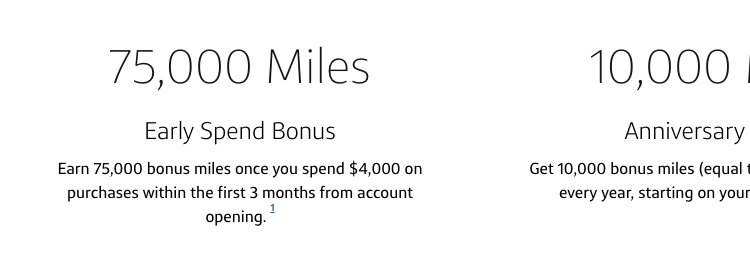
The short version: You see people flying on points and think they are hard to get, or you do not know where to start. This guide starts from zero: no travel card, no points, no idea what a "transfer partner" is. We earn points four ways, and none of them needs a big budget. The biggest single pile is a credit card welcome bonus. On November 8, 2026, Chase's page showed 75,000 points for $5,000 of spending in three months on the Sapphire Preferred, and Capital One's showed 75,000 miles for $4,000 on the Venture X. After the bonus, the card keeps earning on groceries and dinners, 4 points per $1 on the right card. The cheapest pile is Rakuten, a free cash-back site. It pays $50 for joining through a referral and $150 for opening a free Alliant Credit Union checking account, and it can pay both as American Express points instead of cash. The third is Rove, a free hotel booking site that adds airline miles on rooms you were booking anyway. The second half of this guide is the part most beginners never get to: what a point is worth in dollars, where your points can go, and which free tool finds the seat.
Some links below are our referral links. Rakuten, Rove, Roame, seats.aero and point.me pay us when you join or subscribe through them. The offers are the same ones anyone gets, and we say so next to each link.
Before you start: six words you will keep seeing
| The word | What it means |
|---|---|
| Points, or miles | The reward currency a bank, airline, hotel or shopping site gives you. "Miles" has nothing to do with distance; Capital One and Rove just call their points miles. Treat the two words as the same thing. |
| Welcome bonus | A one-time pile of points a bank gives a new cardholder for spending a set amount in the first few months. |
| Spend line, and window | The set amount ("spend $4,000") and the time you get to reach it ("in the first 3 months"). |
| Cash-back site, or portal | A website you visit first. You click from it to the store, the store pays the site a commission for sending you, and the site shares that money with you. Rakuten is one. |
| Transfer partner | An airline or hotel program that accepts your bank's points. Moving points there is called a transfer. |
| Award seat, or award night | A flight seat or hotel room you pay for with points instead of money. The points price is the "award price". |
What a point is worth, the only math you need
A point has no fixed value. It is worth what it buys. Divide the cash price of a flight or a hotel night by the number of points it costs, and you get cents per point. If a $450 flight costs 25,000 points, that is 1.8 cents a point.
To compare piles of points before you have booked anything, we use house values. We set them on May 19, 2026, and use them in every article: Chase 2.0 cents a point, Bilt 2.0, American Express 1.9, Capital One 1.85, Citi 1.8, Wells Fargo 1.6. They are our numbers, not the banks'. In practice, 75,000 Chase points are worth about $1,500 to us. 20,000 American Express points are worth about $380. 5,000 Rove Miles sent to Virgin Atlantic are worth about $75.
That gives you one rule for the whole guide. When a booking beats those numbers, the points did their job. When it falls short, paying cash was the better deal.
One reader, start to finish
Say you start on Sunday, November 8, 2026, with one ordinary credit card and no points anywhere. You spend about $1,200 a month on groceries, gas, your phone and the usual bills. Your pay arrives by direct deposit. You shop online a few times a month and take one trip a year. Each step below ends with what it does for a reader like that, using only the numbers on the companies' own pages that day.
Step 1: Credit card welcome bonuses, the biggest pile from one place
A welcome bonus works like this. A bank wants your business, so it offers new cardholders a one-time pile of points in exchange for spending a set amount on the card in the first few months. The spending is money you would have spent anyway, moved onto one card: groceries, bills, the dentist. Here is what the main cards show on their own pages today. These are the cards whose points can move to airlines and hotels, which matters in the second half of this guide.
| Card | Bonus | Spend line, first 3 months | Per month | Annual fee | Worth at our values |
|---|---|---|---|---|---|
| Chase Sapphire Preferred | 75,000 points | $5,000 | $1,667 | $95 | about $1,500 |
| Chase Sapphire Reserve | 100,000 points | $6,000 | $2,000 | $795 | about $2,000 |
| Capital One Venture X | 75,000 miles | $4,000 | $1,333 | $395 | about $1,388 |
| Capital One Venture | 75,000 miles, plus a $300 credit toward stays in year one, which Capital One calls a limited-time offer | $4,000 | $1,333 | $95 | about $1,388, plus the $300 credit |
| Citi Strata Premier | 60,000 points | $4,000 | $1,333 | $95 | about $1,080 |
| Wells Fargo Autograph Journey | 60,000 points | $4,000 | $1,333 | $95 | about $960 |
| Chase Freedom Unlimited | $200, which Chase tracks as 20,000 points | $500 | $167 | $0 | $200 as cash; about $400 if pooled with a Sapphire card |
Every window above is the first 3 months from account opening, and the "per month" column is the spend line divided by three. All bonus terms were read on the issuers' pages on November 8, 2026. Our welcome bonus page tracks these daily, and the welcome bonus tool does the dollar math for any card you are looking at. One disclosure: Capital One pays us a referral bonus if you apply for the Venture X through our link. The offer is the same 75,000 miles either way.

A no-annual-fee example, with Rakuten paying on top
Not every welcome bonus needs thousands of dollars of spending or an annual fee. Bank of America's Travel Rewards card page, read November 8, 2026: "25,000 online bonus points if you make at least $1,000 in purchases in the first 90 days of your account opening – which can be redeemed for a $250 statement credit toward travel and dining purchases," with "No annual fee." Those points do not move to airlines. They pay you back for travel and dining you buy with the card, at the $250 value Bank of America states. Its Premium Rewards card, read the same day: "60,000 online bonus points — a $600 value — after you make at least $4,000 in purchases in the first 90 days of account opening," with a $95 annual fee.
The same two cards sat on Rakuten's store pages that day: $180 cash back for a new, approved Travel Rewards cardholder (up from $75) and $160 for Premium Rewards, each on the condition that you apply through Rakuten's link and keep the card open at least three months. Through the Amex payout explained in Step 3, $180 is 18,000 Membership Rewards points, on top of the card's own 25,000. Rakuten's rate on card applications moves a lot, and the swings are where the big piles come from. On September 3 we wrote up this same Travel Rewards card at $350 from Rakuten, which is 35,000 Amex points on top of the card's 25,000, and Rakuten raised it to $400 four days later. On October 7 it paid $425 on the Premium Rewards card, 42,500 points as Amex or Bilt. Those runs lasted days, and the November 8 rates are back to $180 and $160.
That is the habit this guide most wants you to pick up: be on the lookout for these offers. They come without warning, they last a few days, and on the same card with the same bank bonus they were worth three times Rakuten's normal rate. Where to look:
- Rakuten's own credit card and Banking & Finance pages, where every store shows its current rate and the rate it replaced ("$180 Cash Back, was $75"). Rakuten's current card offers are inside your Rakuten account; Rakuten pays us a referral bonus when you join through our link.
- Rakuten's one-day card events and double cash back days. We wrote up the September 28 card event and the October 11 double cash back list the day each one ran, and we do the same for every jump we see.
- Our welcome bonus page, which reads the banks' own pages daily, so you can see the card's bonus and Rakuten's payout side by side before you apply.
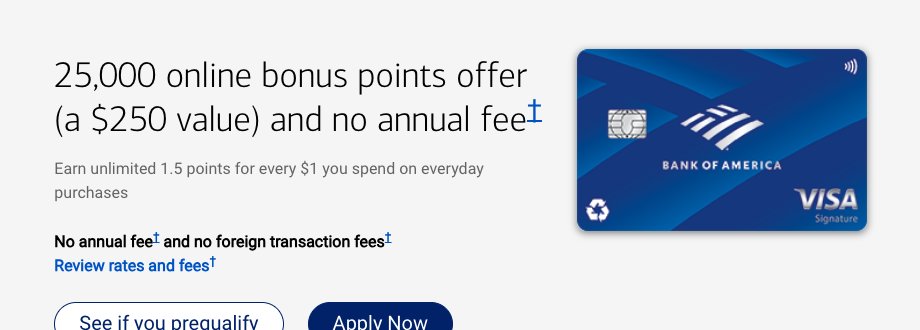
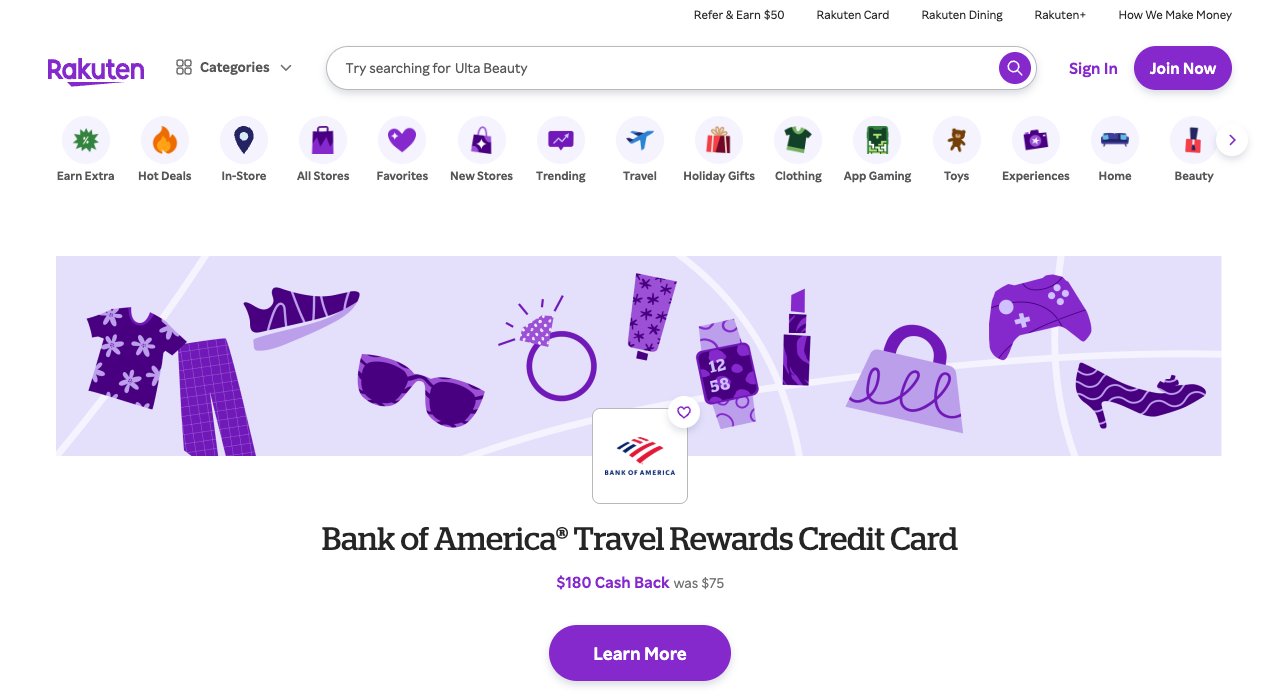
For a reader starting from zero: $1,000 in 90 days is less than one month of that reader's normal spending, and a card with no annual fee puts nothing out of pocket. One application through Rakuten produces two piles: 25,000 Bank of America points, worth $250 toward travel by the bank's own count, and $180 from Rakuten, which can arrive as 18,000 Amex points or as cash.
How a welcome bonus works, start to finish
- You apply and are approved. The clock starts the day the account opens, not the day the card arrives.
- You put your normal spending on the card until you pass the spend line inside the window. Only purchases count. Chase's Sapphire Preferred terms list what does not: "balance transfers, cash advances, cash-like transactions including, but not limited to: travelers checks, foreign currency, money orders, wire transfers." The annual fee is billed to the card and does not count either.
- The bonus lands on your account, usually one or two statements after you cross the line.
- You pay the statement in full every month. A bonus worth $1,500 is gone in a few months if the balance sits at a card's interest rate.
For a reader starting from zero: $1,200 a month is $3,600 over three months. That clears the $500 line on the Freedom Unlimited many times over. It falls $400 short of the $4,000 lines and $1,400 short of the $5,000 line, unless a planned purchase, such as a flight, insurance or a repair, happens to land in the window. The spend line is the first number to compare with your own three months. The annual fee is the second, because it is money out of your pocket in the first month, while the points arrive later.
What the marketing doesn't tell you
- One bonus per card, and the banks check. Chase's Sapphire Preferred page: "The new cardmember bonus may not be available to you if you previously held this card or received a new cardmember bonus for this card. We may also consider the number of cards you have opened and closed in determining your bonus eligibility." That last sentence is the closest Chase comes to printing its 5/24 practice, which we explain in our 5/24 guide. Capital One's Venture page says you are not eligible "if you have received a new cardmember bonus for the Capital One Venture card or the Capital One Venture X card in the past 48 months." Citi: the Strata Premier bonus "is not available if you currently have or previously had a Citi Strata Premier® or a Citi Premier® account." Wells Fargo: no bonus if you "have the card product you are applying for or opened one within the last 48 months."
- American Express does not print one public number. Its Gold and Platinum offers appear during the application and differ from person to person. We never quote an Amex welcome bonus for that reason. Read the offer on your own screen before you apply.
- "Cash back" on a Chase Freedom card is points. Chase's own terms: "Cash Back rewards are tracked as points and each $1 in Cash Back rewards earned is equal to 100 points." On its own, the Freedom Unlimited's $200 is $200. If you also hold a Sapphire Preferred, Sapphire Reserve or Ink Business Preferred, the same 20,000 points can be moved into that account and then to airlines, which is why the table shows both values.
- Rakuten pays on top of some card applications, and not only Bank of America's. On November 8, Rakuten's store page showed $150 cash back for a new, approved Citi Strata Premier cardholder (up from $50), on the same condition: apply through Rakuten's link and keep the card open at least three months. That money arrives as Rakuten cash back, which, as Step 3 explains, can arrive as Amex or Bilt points instead. Our Rakuten and credit card stacking guide walks through the order.

Step 2: Everyday spending, the right card for each purchase
After the bonus, the card keeps earning on everything you buy, and the rate depends on the card and on what you are buying. People who travel on points usually carry two kinds of cards. A category card earns a high rate on one or two things they buy a lot, such as groceries and restaurants. A catch-all card earns a flat rate on everything else. Here are the examples we use, with the rates read on the issuers' own pages on November 8, 2026.
| Card | Role | Earns | Annual fee | Points it earns |
|---|---|---|---|---|
| American Express Gold | category card | 4 points per $1 at restaurants worldwide and at U.S. supermarkets, with yearly caps (below) | $325 | Amex Membership Rewards |
| Chase Freedom Flex | category card, rotating | 5 points per $1 in that quarter's categories, up to $1,500 a quarter, once you activate; 3 per $1 on dining and drugstores; 1 per $1 on everything else | $0 | Chase points, which move to airlines only when pooled with a Sapphire or Ink Business Preferred card |
| Capital One Venture X | catch-all | 2 miles per $1 on everything; 10 per $1 on hotels and rental cars and 5 per $1 on flights and vacation rentals booked through Capital One Travel | $395 | Capital One miles |
| Capital One Venture | catch-all | 2 miles per $1 on everything; 5 per $1 on hotels, vacation rentals and rental cars booked through Capital One Travel | $95 | Capital One miles |
| Chase Freedom Unlimited | catch-all, no fee | 1.5 points per $1 on everything; 3 per $1 on dining and drugstores; 5 per $1 on travel booked through Chase Travel | $0 | Chase points, same pooling rule |
Chase's Freedom Flex page also shows the current 5% categories. For October through December 2026 they are dining and American Red Cross donations; for January through March 2027, grocery stores (excluding Walmart and Target) and top streaming services, with activation opening December 15, 2026.
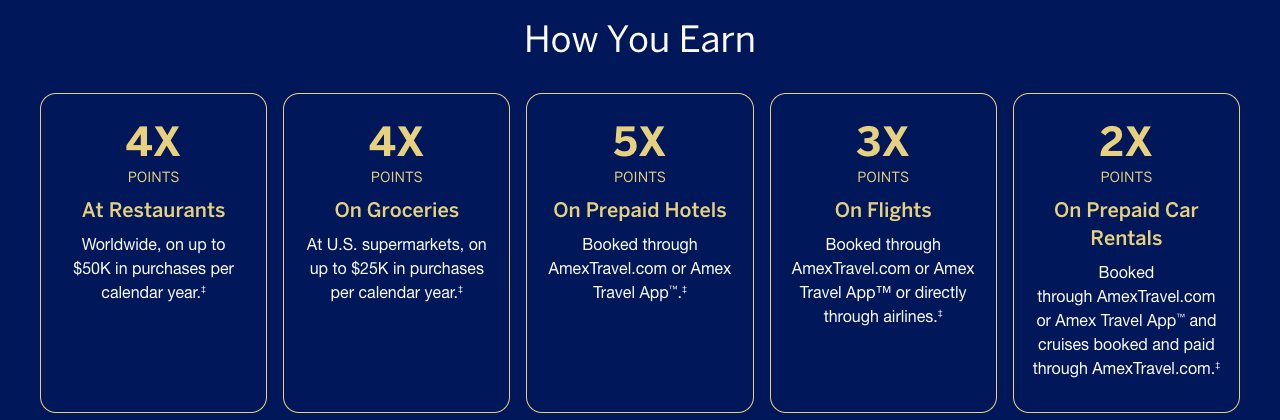
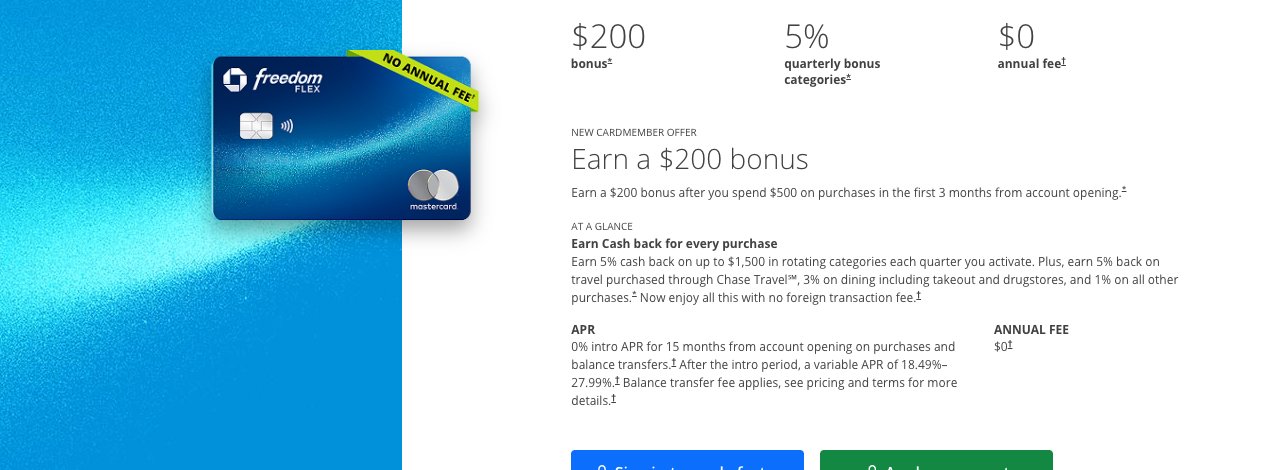
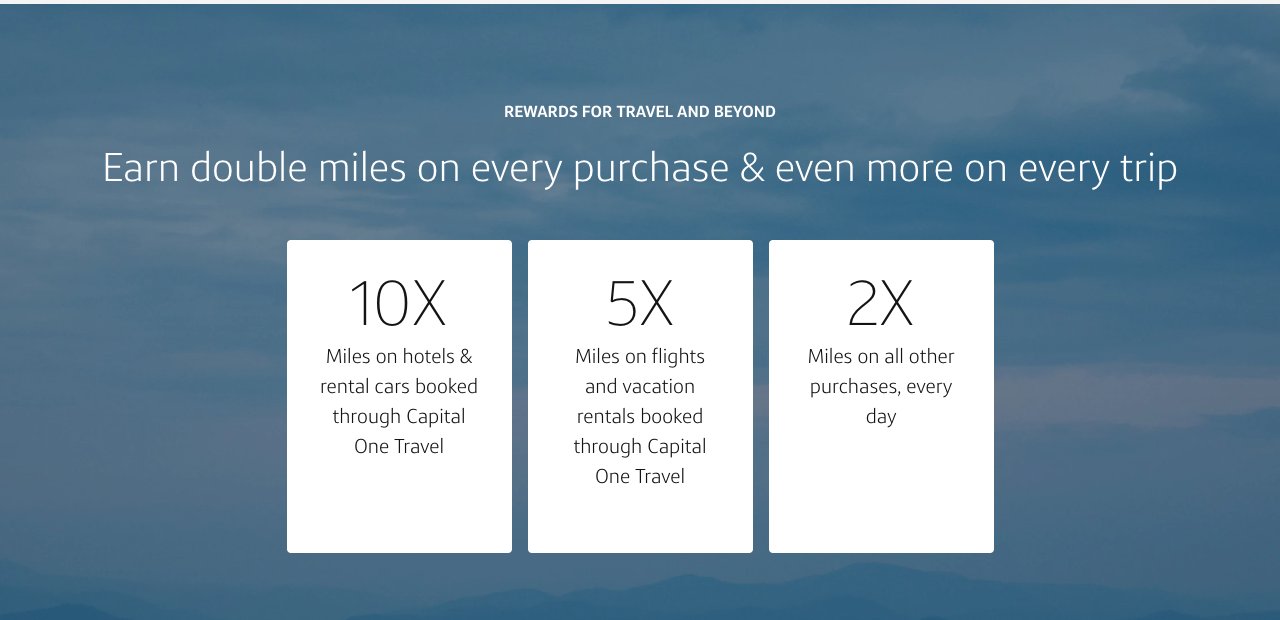
The math that decides it. Say the $1,200 a month from the reader above splits into $500 of groceries, $150 at restaurants and $550 of everything else. On one card that earns 1 point per $1, that is 1,200 points a month, 14,400 a year. Split by category, the same money earns two separate piles. The $650 of groceries and restaurants on a 4-points-per-dollar card is 2,600 Amex points a month, 31,200 a year, worth about $593 at our 1.9-cent value, well under the Gold's yearly caps. The $550 of everything else on a 2-miles-per-dollar catch-all is 1,100 Capital One miles a month, 13,200 a year, worth about $244 at our 1.85-cent value. The two piles stay separate; Amex points and Capital One miles do not add together, and each moves to its own list of airlines. Against that sit the annual fees: $325 for the Gold, $95 for the Venture or $395 for the Venture X, charged before the points arrive. The no-fee version of the same split is the Freedom Flex for its 5% quarters and 3% dining plus the Freedom Unlimited at 1.5% on the rest, all of it Chase points.
For a reader starting from zero: the habit is one rule at the register. Groceries and restaurants go on the category card, everything else goes on the catch-all, and the statement is paid in full. On $1,200 a month that rule is the difference between 14,400 points a year and the two piles above.
What the marketing doesn't tell you
- The high rates have ceilings. American Express's page, in its own words: 4X points at restaurants worldwide "on up to $50,000 in purchases per calendar year, then 1X points," and 4X at U.S. supermarkets "on up to $25,000 in purchases per calendar year, then 1X points for the rest of the year." Chase's Freedom Flex page: "Earn 5% cash back on up to $1,500 in rotating categories each quarter you activate." Miss the activation and the quarter pays 1%.
- "Cash back" on the Freedom cards is points. Chase's own terms: "Cash Back rewards are tracked as points and each $1 in Cash Back rewards earned is equal to 100 points." Those points move to airlines only if you also hold a Sapphire Preferred, Sapphire Reserve or Ink Business Preferred and pool them there.
- Interest beats the points. Chase lists a variable 18.49% to 27.99% for the Freedom Flex, and American Express lists 19.74% to 28.74% for the Gold's Pay Over Time feature. The points on the same dollars are worth about 2 to 4 cents per dollar at our values. A balance carried for a year costs far more than the points it earned.
- The welcome bonus is still the bigger number. A year of the split above earns 31,200 Amex points; one Sapphire Preferred bonus in Step 1 was 75,000. Everyday earning is the steady pile, not the big one.
Every card above has its own page on our site with the full earn table and the credits that offset the fee: American Express Gold, Freedom Flex, Venture X, Venture, Freedom Unlimited. Capital One pays us a referral bonus if you apply for the Venture X through our link; the earn rates are the same either way.
Step 3: Rakuten, $50 for joining, and your cash back can become points
Rakuten is a cash-back site. You go to Rakuten first, click through to a store you were going to buy from anyway, and buy as normal. The store pays Rakuten a commission for sending you, and Rakuten shares it with you as cash back. Using it takes four habits:
- Join once, free. Our link carries the $50 referral bonus described below.
- Add Rakuten's browser button, or use its app on your phone. The button reminds you when a store you are on pays cash back.
- Start every online purchase from Rakuten, or tap the button before you pay. If you forget, there is no cash back for that order.
- Watch the cash back show up in your Rakuten account. It is marked confirmed once the store reports the sale, which Rakuten says takes 3 to 14 weeks for store purchases and 6 to 17 weeks for travel.
Two things turn Rakuten from a coupon site into a points engine.
First, the join bonus. Join Rakuten through our link and Rakuten's referral page says you get "$50 bonus when you spend $50." The terms, read November 8: the new member must sign up "during the period beginning 12:00 AM PT October 1, 2026 and ending 11:59 PM PT December 31, 2026" and make "Qualifying Purchase(s) totaling at least $50 within 90 days of signing up." Both of you have to live in the U.S. Rakuten pays us $50 too, which is our referral bonus, and we say so because that is the rule here. Without a referral, the same page offers "$20 Welcome Bonus when you spend $25."

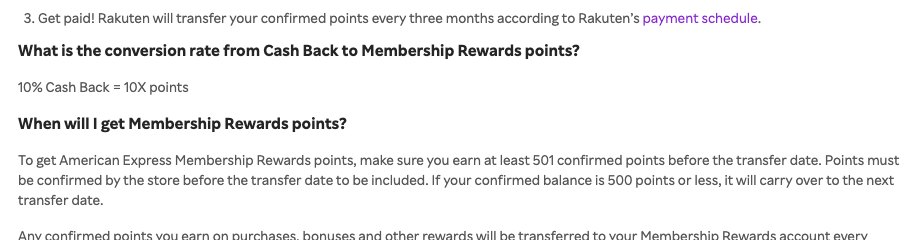
Second, how you get paid. Rakuten's "When Will I Get Paid?" page lists the choices: "PayPal, Bilt Points, Samsung Cash or check. Additionally, eligible American Express® Card Members can choose to earn Membership Rewards® points instead of Cash Back." Membership Rewards is the points program attached to American Express cards such as the Gold, Green and Platinum. The conversion is on Rakuten's Amex FAQ: "10% Cash Back = 10X points." In plain words, every $1 of cash back becomes 100 Amex points. Rakuten says bonuses convert too: "Any confirmed points you earn on purchases, bonuses and other rewards will be transferred to your Membership Rewards account." So the $50 join bonus is 5,000 Amex points if you hold an eligible Amex card.
Bilt Rewards, a points program whose points also move to airlines and hotels, works the same way with one difference. Bilt's support page: "Blue members: 50 points per $1 in Rakuten cash-back" and "Silver, Gold, and Platinum members: 100 points per $1 in cash-back." Your Bilt status on the payout date sets the rate. Bilt is the points route for people who hold no Amex card.
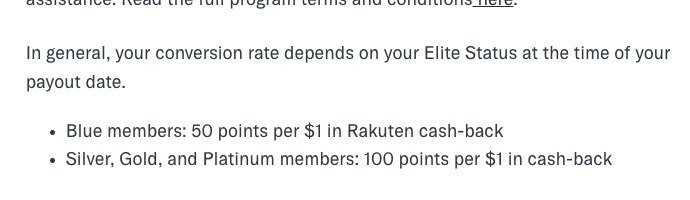
For a reader starting from zero: join today, and $50 of ordinary Rakuten shopping before February 6, 2027 earns the $50 bonus. Rakuten pays four times a year, so the first payment date you can reach is Monday, February 15, 2027. With an eligible Amex card and the payout set to points, the $50 is 5,000 Membership Rewards points. With a Bilt account it is 2,500 Bilt points at Blue status, or 5,000 at Silver, Gold or Platinum. With neither, it is $50 to PayPal.
What the marketing doesn't tell you
- Amazon does not count toward the join bonus. Rakuten's welcome bonus terms: purchases on Amazon.com "shall not be considered Qualifying Purchases," except Amazon Music.
- Rakuten pays four times a year, not when you shop. Payment dates are February 15, May 15, August 15 and November 15. Cash back has to be confirmed first. You also need at least $5 of confirmed cash back, or 501 confirmed points, on the date, or it rolls to the next one.
- Set the payout method before the first payment date. Rakuten's FAQ says cash back earned before you switch to points "will be converted to points and sent by the next transfer date," so switching late is fine. Switching after a payout is money already sent to PayPal.
Rakuten also runs rate events that we cover as they land: double cash back days, its holiday Big Deal Reveal, and one-day travel bonuses. Our Rakuten and card stacking guide has the mechanics that stay true between events.
Step 4: Rove, airline miles on hotel rooms you book anyway
Rove is a free hotel booking site and app with its own currency, Rove Miles. There is no card to apply for and no fee. Its home page, read November 8: "Earn up to 25x airline miles when you book hotels with Rove. Stack with your usual credit card rewards." In practice, four steps:
- You sign up, free. Our link is a referral link, explained below.
- You search for the hotel you were going to book anyway. Rove shows the room price and the mile rate for that room before you confirm. Rove's help center says the rate "varies by hotel and booking type," so the 25x is the ceiling, not the floor.
- You pay with whatever card you already use. That card's own points still post, because to the card it is just a hotel purchase.
- Rove adds its miles on top. Nonrefundable rooms post the miles right away; refundable rooms post after you check out.

The math that decides it. Take a $200 room. At a 25x rate, Rove pays 5,000 Rove Miles. A typical travel card pays 2 points per dollar on the same room, which is 400 points. You get both, because you paid with the card.
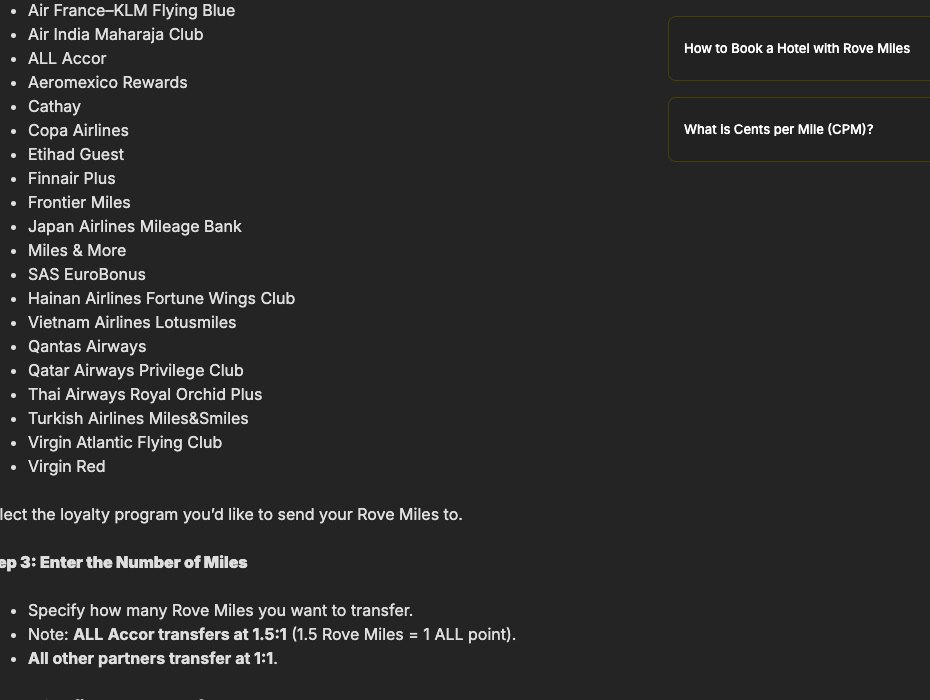
Where Rove Miles go. Rove Miles are not airline miles yet. You move them to an airline or hotel program when you are ready to book, which is the "transfer" from the word list above. Rove's transfer page, updated August 31, 2026, lists 21 partner programs, among them Air Canada Aeroplan, Air France-KLM Flying Blue, Japan Airlines Mileage Bank, Qatar Airways Privilege Club, Turkish Airlines Miles&Smiles, Virgin Atlantic Flying Club and ALL Accor for hotels. Rove's own line on ratios: "ALL Accor transfers at 1.5:1 (1.5 Rove Miles = 1 ALL point). All other partners transfer at 1:1." A 1:1 ratio means 1,000 Rove Miles become 1,000 airline miles. Rove added JetBlue TrueBlue as a 1:1 partner this fall, and our tracker shows a 20% bonus on Rove to JetBlue transfers through November 14. We priced one Rove booking in September: New York to London for 6,000 Virgin Atlantic miles, and that article shows the taxes that ride along with an award seat.
Beyond hotels. Rove's help center counts three ways to earn: shopping through its browser extension or portal, hotels and flights booked through Rove, and referrals. Sign up for Rove through our link. Rove pays us referral miles once you earn your first 250 Rove Miles, which is Rove's own rule for referrers: the friend has to earn "at least 250 Rove Miles through qualifying activity." Rove's public pages do not state a sign-up bonus for the new member, so we are not quoting one.
For a reader starting from zero: one $200 weekend room, booked through Rove at a hotel showing 25x, earns 5,000 Rove Miles. Sent 1:1 to Virgin Atlantic, we value those at about $75. The same room also earns your card's own points, 400 of them on a 2-points-per-dollar card, worth about $8 at our Chase value. That is the whole idea: a room you were paying for anyway earns twice.
What the marketing doesn't tell you
- Refundable rooms wait for checkout. Rove's posting page: "Nonrefundable bookings: Miles post immediately. Refundable bookings: Miles post within 1 day after checkout." Bookings marked Loyalty Eligible, the ones that also earn the hotel's own points, post "between 8-12 weeks after checkout."
- Shopping miles are slow. Rove's own timeline for shopping miles: pending for "24 hours to 10 days," posted "between 60 to 100 days." Plan a trip around hotel miles, not shopping miles.
- Accor is the one partner where the ratio costs you. 1.5 Rove Miles become 1 Accor point. Every other partner is 1 to 1.
Our Rove Miles complete guide goes deeper on the app and the partners. The transfer partner matrix shows the Rove column beside the banks'.
Step 5: Points without spending much, bank accounts through Rakuten
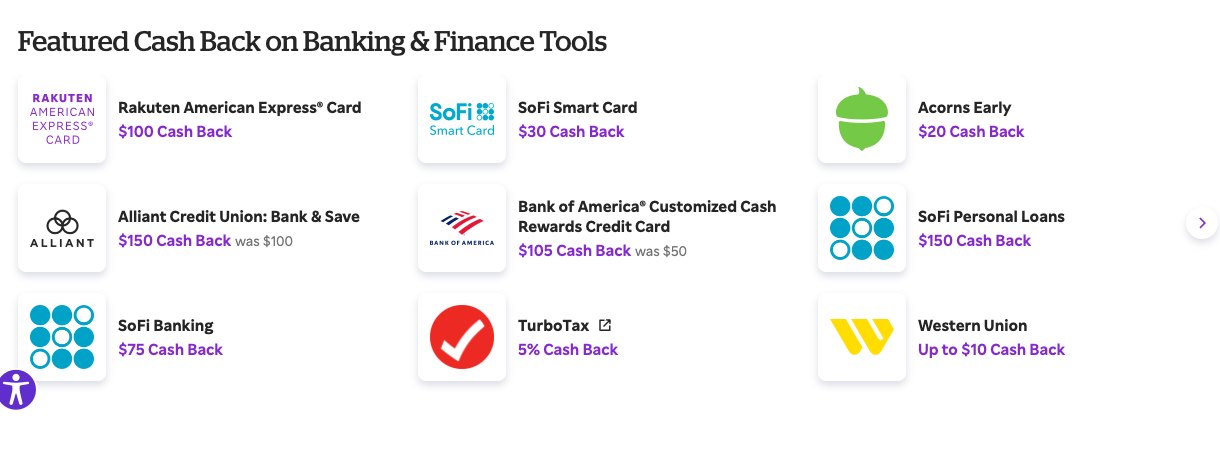
This is the part most people miss. Rakuten's Banking & Finance page pays cash back for opening accounts, not for buying things. On November 8 the featured offers included $150 for an Alliant Credit Union checking account (up from $100), $75 for SoFi Banking, $50 for Chime, and $50 for a Valley Direct high-yield savings account. Through the Amex option from Step 3, those dollars are points.
| Account on Rakuten | Rakuten pays | The conditions Rakuten lists | As Amex points |
|---|---|---|---|
| Alliant Credit Union High-Rate Checking | $150 (was $100) | new Alliant member; $500 deposit at opening; a $500 direct deposit from an employer or government agency within 30 days of clicking; 5 debit card purchases of $10 or more within 45 days; $1,000 in the account on day 45 | 15,000 |
| SoFi Checking and Savings | $75 | new SoFi account; a net initial direct deposit of $500 or more within 45 days of clicking | 7,500 |
| Chime Checking | $50 | first Chime account; a qualifying direct deposit of $200 or more from an employer, payroll provider, gig payer or benefits payer within 30 days of opening | 5,000 |
| Valley Direct High Yield Savings Promo Account | $50 | new Valley customer; $1,000 opening deposit of new money | 5,000 |
Read on Rakuten's store pages on November 8, 2026. Rakuten's own line on each: cash back is "provided by Rakuten," not by the bank, and it is one offer per Rakuten account.
Three of the four hinge on a direct deposit, so here is what that word means. A direct deposit is pay that your employer, or a government agency such as Social Security, sends straight into the account. If your employer lets you split your paycheck between two accounts, part of it can go to the new one; that is the usual way people meet these conditions. Moving money over from your old bank yourself does not count, and the terms say so.
The math that decides it. The Alliant offer plus the Step 3 join bonus is $200 of Rakuten cash back. As Amex points that is 20,000 Membership Rewards points, worth about $380 at our value, for a free checking account, $50 of debit card purchases you would have made anyway, and $50 of Rakuten shopping. As Bilt points it is 20,000 at Silver, Gold or Platinum status, or 10,000 at Blue. As cash it is $200. We wrote the full Alliant walkthrough on October 31: 20,000 Amex points without a new credit card. Alliant's page says "Anyone can apply to join Alliant."
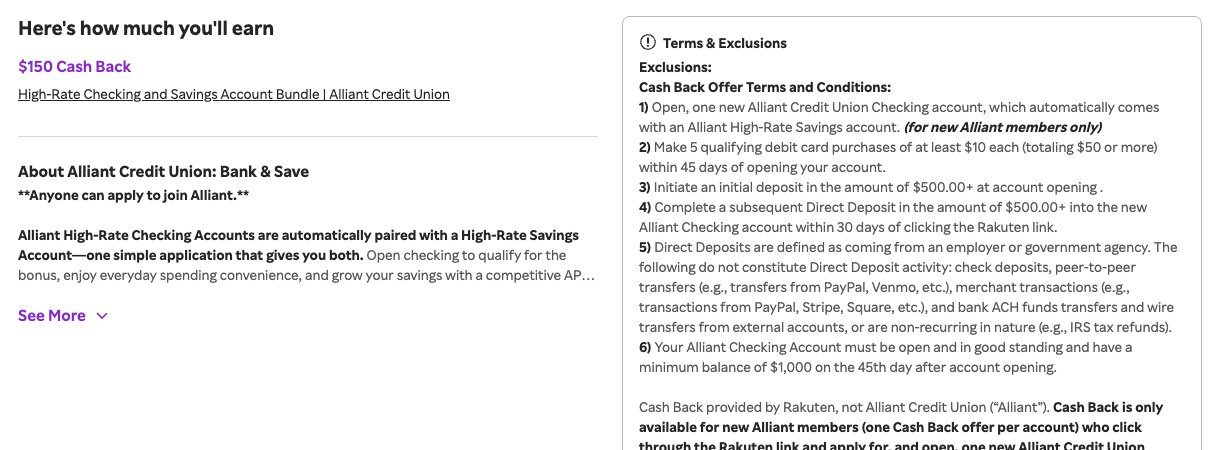

For a reader starting from zero: your pay already arrives by direct deposit, so the Alliant conditions are a payroll form and a calendar. Click on November 8, and the $500 direct deposit is due by December 8. The 45-day balance check lands on December 23. The $150 posts to Rakuten "within a few months," then waits for the next quarterly payment date, so count on spring, not Christmas.
What the marketing doesn't tell you
- "Direct deposit" means your employer or the government. Rakuten's Alliant terms spell out what does not count: "check deposits, peer-to-peer transfers (e.g., transfers from PayPal, Venmo, etc.), merchant transactions ... and bank ACH funds transfers and wire transfers from external accounts, or are non-recurring in nature (e.g., IRS tax refunds)." Chime's terms exclude the same kinds of transfers. These offers depend on being able to send part of a paycheck to the new account.
- The clock starts when you click, not when the account opens. Alliant's $500 direct deposit is due "within 30 days of clicking the Rakuten link."
- The money is slow. Alliant's offer posts to Rakuten "within a few months," SoFi's "can take several weeks or longer." Then it waits for the next quarterly payment date.
- The bank's own bonus is separate. SoFi's own page offers a direct deposit bonus, which Rakuten's blurb puts at "up to $400," with its own rules. Rakuten's $75 is on top of whatever the bank pays, if you qualify for both.
Bank bonuses are also how one of our favorite trips started: a $250 bank bonus that became two nights at Alila Ubud, via Bilt and World of Hyatt.
Now you have points. How do you spend them?
What is a point worth where you hold it?
Not one cent. The same 10,000 points can be worth $14 or $40 depending on where you send them; we showed the two bookings in Rewards, Explained part 2. Our valuations page lists every program we track with the date each value was set. The test for any booking is the one from the top of this guide: cash price divided by points price. Compare the result with the value of the points you are about to spend.
The two ways to spend bank points
Bank points, the kind the cards in Step 1 earn, can be spent two ways. The first is through the bank's own travel site, where the bank sets a fixed rate for every point and you book the way you would on any travel site. The second is to move the points to an airline or hotel program, a transfer, and then book an award seat or award night there. The second way is where the big values are, and it is the part that confuses beginners, so the rest of this section is about it.
Where can your points go?
Airline and hotel programs that accept your bank's points are its transfer partners. Our transfer partner matrix lists where each currency goes and at what ratio: 20 partners for Amex Membership Rewards, 15 for Chase Ultimate Rewards, 24 for Capital One, 20 for Citi ThankYou, 24 for Bilt, 10 for Wells Fargo and 22 for Rove, as of November 8. Three rules hold everywhere:
- Transfers are one way. Once points land in an airline program, they stay there. Find the seat first, then move the points.
- Ratios matter. Capital One's own guide: "Conversion ratios indicate the value of transferring miles. For example, a 1:1 ratio means 1,000 Capital One miles will become 1,000 miles or points when transferred." Most of its airline partners are 1:1, some are 2:1.5. Our matrix shows every ratio.
- Minimums and timing differ. Capital One's guide: "To transfer Capital One rewards to a travel partner, you must have at least 1,000 Capital One rewards miles. The name on your Capital One account also has to match the name on your travel loyalty program." Most transfers are instant; some take days. Rove's wording: "Some transfers are instant, while others may take a little longer to appear."
How booking with points works, step by step
- Pick the trip and a few possible dates. Flexible dates matter more with points than with cash, because airlines release only some seats at the low points prices.
- Search for seats you can pay for with points. You can do that on each airline's own site, one program at a time, or with one of the free tools in the next part, which search many programs at once.
- Note the points price and the taxes and fees. Every award seat has a cash part, which you pay with a card.
- Check which of your points move to that airline, and at what ratio, on our transfer partner matrix. Check the transfer bonuses page too.
- Move the points from your bank to the airline. Then book on the airline's site, where the seat now shows as something you can pay for with miles.
Should you wait for a transfer bonus?
A transfer bonus is a limited-time offer where the airline or hotel adds points on top of a transfer. Move 1,000 points during a 30% bonus and 1,300 arrive. Our tracker, which keeps the end dates, showed these live on November 8, 2026:
| From | To | Bonus | Last day |
|---|---|---|---|
| Chase | IHG One Rewards | 80% | December 3 |
| Chase | Aer Lingus, British Airways, Iberia (Avios) | 30% | December 1 |
| Chase | Wyndham Rewards | 30% | December 3 |
| Amex | Marriott Bonvoy | 35% | December 10 |
| Capital One | Air France-KLM Flying Blue | 20% | November 30 |
| Capital One | Virgin Atlantic Flying Club and Virgin Red | 30% | November 20 |
| Capital One | Copa Airlines ConnectMiles | 30% | December 1 |
| Citi | Cathay Pacific | 10% | November 14 |
| Rove | JetBlue TrueBlue | 20% | November 14 |
A big percentage on a cheap currency can still lose to a plain 1:1 transfer into a strong one. Chase to IHG at 80% turns 1,000 Chase points into 1,800 IHG points. At our 0.6-cent IHG value, those are worth about $10.80. The same 1,000 Chase points sent 1:1 to World of Hyatt, which we value at 1.63 cents, are worth about $16.30. The bonus that did pay this month: 66,000 Capital One miles or Amex points became 85,800 Virgin Atlantic points with the 30% bonuses, enough for an ANA First Class seat from New York to Tokyo that Google Flights priced at $15,728 for January 13, 2027, as we showed in our November roundup. The live list is always on our transfer bonuses page, and every bonus we priced in 2026 shows how rarely the percentage alone decides it.
Which tool finds the seat?
Airlines release a limited number of seats at the low points prices, and searching program by program is slow. Three tools search many programs at once. In one sentence each: seats.aero shows you where your points can take you on a map and a calendar; Roame watches for seats and emails or texts you when one appears; point.me finds the seat and then tells you, step by step, how to book it. We compared them in August and re-read their pages on November 8, 2026.
| Tool | Free tier | Paid tier, read November 8 | Best at |
|---|---|---|---|
| seats.aero | search without an account for departures within the next 60 days; up to 5 active alerts; its browser extension shows points prices beside cash fares on Google Flights, Chase Travel and Amex Travel | Pro: unlimited alerts, results beyond 60 days, live searches, full filters, faster refresh (price on its site) | "Where can my points take me?" |
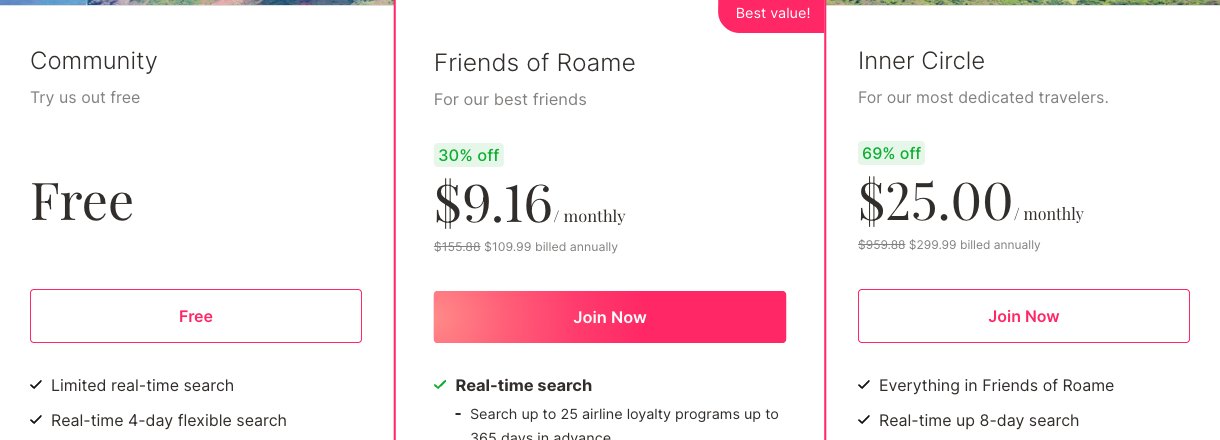
| Roame | limited real-time search, 4-day flexible search, a 7-day window for flights within 60 days, free deals emails | Friends of Roame $109.99 a year (shown as 30% off $155.88), searches up to 25 programs 365 days out, 10 multi-region alerts; Inner Circle $299.99 a year | alerts and deals |
| point.me | search up to 60 days out, 15 results per search, weekly deals newsletter | Standard $129 a year (shown as 46% off $239): unlimited real-time search up to a year out, step-by-step booking instructions, 3 price alerts; Premium $260 a year | telling you how to book what it finds |
Our code REWARDSGURUCLUB takes 10% off Roame's paid plans. Roame, seats.aero and point.me pay us a commission when you subscribe through the links above.
When to pay for one. Both paid tools already show a struck-through price on their plan pages (Roame 30% off, point.me 46% off, read November 8). We expect deeper Black Friday offers on these memberships, and we post each code on our deals page the day it goes live. If you are going to pay for a year, Friday, November 27, 2026 is the date to compare against. The free tiers are enough to learn on until then. One more free door: American Express cardholders with Membership Rewards get point.me's Amex version at amex.point.me, which searches the airlines Amex points can reach and logs in with your Amex credentials.
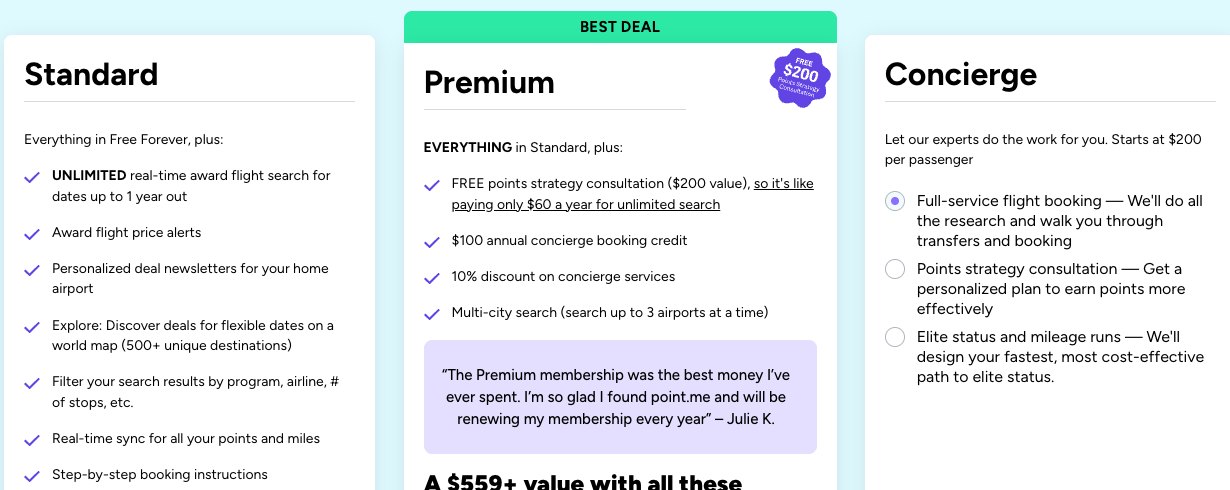
The full comparison, including what each one cannot do, is in seats.aero vs point.me vs Roame. Our own sweet spot finder lists the bookings we have priced ourselves.
Points prices go on sale too
Airlines run award sales the way they run fare sales. Today's example: Southwest's award sale, which we priced this morning, cut one Las Vegas to Denver flight from 9,000 points to 6,000 for travel in February. You spot one the same way everywhere: search in points and look for a crossed-out price.
Your first year, on paper
For the reader who started from zero on November 8, here is where each pile stands a year later, each currency on its own line, because points from different programs do not add together.
- Rakuten: the $50 join bonus and the $150 Alliant offer, $200 of cash back. Paid as 20,000 Amex points with an eligible Amex card, as Bilt points, or as $200 to PayPal. The join bonus arrives February 15, 2027; the Alliant money follows on a later quarterly date.
- A card bonus, if you applied for one of the cards above and cleared its spend line: 60,000 to 100,000 points, in that bank's currency. At our values, 75,000 Chase points are about $1,500.
- Everyday spending, with the Step 2 split: about 31,200 Amex points from $650 a month of groceries and restaurants on a 4-points-per-dollar card, and 13,200 Capital One miles from the other $550 on a 2-miles-per-dollar card, each in its own pile.
- Rove: 5,000 Rove Miles for every $200 room booked at a hotel showing 25x, plus your card's own points on the same rooms.
- Spending them: one award seat found on a free tool, with the points moved only after the seat was found.
The order we would do it in, starting from zero
- Join Rakuten first, through our link, because the $50 bonus has a December 31, 2026 sign-up deadline and a 90-day spending window. Set the payout to Amex points if you hold an eligible Amex card, Bilt points if you are a Bilt member, PayPal if you are neither.
- If you are opening a bank account anyway, start from Rakuten's Banking & Finance page. Read the direct deposit rule before you click.
- If you are applying for a card anyway, read two pages first: Rakuten's card offers, and the issuer's own terms on previous bonuses. Compare the spend line with your own three months. Rakuten's card payouts spike for a few days at a time, as the Bank of America example shows, and the spike is the part worth waiting a few days for. Our welcome bonus page has the current offers and dates.
- Put each purchase on the card that earns the most for it: groceries and restaurants on the category card, everything else on the catch-all, statement paid in full.
- Book hotels through Rove when its rate for your hotel is shown, after signing up through our link, and pay with the card you were going to use.
- Before any transfer, find the seat or the night on a free tool, check our transfer bonuses page, and divide the cash price by the points price. If a paid search plan is on your list, wait for the Black Friday prices on our deals page before paying for a year.
Mistakes that cost beginners the most
- Buying without starting at Rakuten. The cash back exists only when the store knows Rakuten sent you.
- Not watching for the spikes. Rakuten's payout on the Bank of America Travel Rewards card was $125 on a normal day this fall and $350, then $400, for a few days in September; the Premium Rewards card hit $425 in October. Same card, same bank bonus, three times the Rakuten money.
- Carrying a balance on the new card. Interest eats the bonus.
- Calling a transfer from your old bank a "direct deposit." Rakuten's bank offers say it does not count.
- Moving points before finding the seat. Transfers are one way.
- Expecting Rakuten money in weeks. It arrives on the quarterly dates after confirmation, so the first payment for anything started today is February 15, 2027.
- Booking a refundable room on Rove and wondering where the miles are. They post after checkout; Loyalty Eligible rates take 8 to 12 weeks.
More words you will see, in plain English
The six at the top of this guide, plus these:
| Word | Plain English |
|---|---|
| Annual fee | What the bank charges each year to hold the card. It is billed to the card and does not count toward a spend line. |
| Cents per point | Cash price divided by points price. The value test for any booking. |
| Confirmed cash back | Cash back the store has reported to Rakuten, so Rakuten will pay it on the next payment date. |
| Direct deposit | Pay sent straight into an account by an employer or a government agency. A transfer you make yourself is not one. |
| Membership Rewards, Ultimate Rewards, ThankYou | American Express's, Chase's and Citi's names for their points. |
| Transfer | Moving points from a bank or from Rove into an airline or hotel program. One way. |
| Transfer bonus | A limited-time offer where the airline or hotel adds a percentage on top of a transfer. |
| Transfer ratio | How many of your points become one of theirs. 1:1 means 1,000 become 1,000. |
Sources, read November 8, 2026
- Chase Sapphire Preferred, Sapphire Reserve, Freedom Flex and Freedom Unlimited pages on creditcards.chase.com; Capital One Venture X and Venture pages on capitalone.com; American Express Gold Card page on americanexpress.com (earn rates, caps and fee only; we never quote an Amex welcome offer); Citi Strata Premier page on citi.com; Wells Fargo Autograph Journey page on creditcards.wellsfargo.com; Bank of America Travel Rewards and Premium Rewards pages on bankofamerica.com; Bilt card page on bilt.com. Welcome bonus figures are current as of November 8, 2026 and change often; confirm the live offer on the issuer's page before applying.
- Rakuten: Refer-a-Friend page and terms, Welcome Bonus Terms, "When Will I Get Paid?", the American Express Membership Rewards Points FAQ, the Banking & Finance page, and the Alliant Credit Union, SoFi Banking, Chime, Valley Direct, Citi Strata Premier, Bank of America Travel Rewards and Bank of America Premium Rewards store pages, all on rakuten.com. The earlier Rakuten rates on the Bank of America cards ($350 on September 3, $400 on September 7, $425 on October 7) are from our own dated articles, linked above. Rakuten's referral offer period ends December 31, 2026; store rates change without notice.
- Bilt x Rakuten support article on support.biltrewards.com.
- Rove: home page, "What are Rove Miles?", "How to Earn Miles on Hotel Bookings", "Miles Pending and Posting Timelines", "How to Transfer Rove Miles to Partner Programs" (updated August 31, 2026) and "Where Are My Referral Miles?" (updated October 6, 2026) on rove.com and help.rove.com.
- Capital One miles transfer partners guide on capitalone.com, including its 1,000-mile transfer minimum. Roame membership page on roame.travel. point.me plans page and amex.point.me. seats.aero help center articles "Free vs. Pro: What's included", "Do you offer a free account?" and the browser extension FAQ on docs.seats.aero.
- Our own data: house point values from our valuations page (bank points set May 19, 2026), the transfer partner matrix and transfer bonus tracker as of November 8, 2026, and the priced examples linked above with their own dates.
Cover: generated image, no real brands shown.
Related articles
- seats.aero vs point.me vs Roame: Three Award Search Tools, Three Different Jobs
- If You Think 20,000 Amex Points Takes a New Credit Card, You May Be Wrong: Rakuten Is Paying $150 to Open a Free Alliant Checking Account, Plus $50 for Joining, and Pays Both as Points
- Transfer Bonus History: Every Bank-to-Airline Bonus We Priced in 2026, and Which Were Worth It
- A No-Annual-Fee Card That Pays Up to $715 Back on $1,000: Rakuten's $400, Bank of America's 25,000 Points, and $50 More If You Are New to Rakuten
Do this with your own numbers
- Transfer partners — every program, ratio and live transfer bonus, checked daily
- Bonus tracker — today's welcome bonuses, verified on the issuer's page