As an Amazon Associate I earn from qualifying purchases.
The mountain days start tomorrow. Pilatus first, then the Jungfrau region, then Saas-Fee, and every one of them has the same shape: a cable car or a cogwheel does the height, and the walking happens on marked paths between the stations. We never went into the woods, and we never left a path. That turned out to be most of the advice. Before those posts, a short note on the thing we had not thought about until the week before we left: ticks.
What the Swiss health office says
The Federal Office of Public Health, the FOPH, puts it in one sentence on its tick-borne encephalitis page: "The whole of Switzerland with the exception of canton Ticino must be regarded as a TBE risk area." The same page says where the ticks are: they "primarily live in deciduous forests and woods with extensive undergrowth, and are found throughout Switzerland at elevations of up to around 2,000 metres above sea level." The lifts do the height on a mountain day, and the walking happens below it, inside that band, along the forest edges and meadows the paths are cut through.
The office's disease dashboard adds the timing. Tick-borne illness can appear all year, and the peak is summer. Our trip ran from the last days of August into September, so we were walking in the peak.
There are two diseases behind the warning, and they are not the same kind of problem.
Lyme disease is bacterial. The FOPH counts "around 9,150 reported cases per year" in Switzerland, and its dashboard's running estimate for 2026 stood at 5,675 cases on 18 August. The CDC describes it plainly: "Typical symptoms include fever, headache, fatigue, and a characteristic skin rash called erythema migrans," and "Most cases of Lyme disease can be treated successfully with a few weeks of antibiotics." So the job with Lyme is to notice it.
Tick-borne encephalitis, TBE, is a virus. The dashboard's 2026 count stood at 343 cases on the same date. The FOPH says that "seven to 14 days after being bitten by an infected tick, an individual may notice the first signs of TBE in the form of flu-like symptoms," and the CDC lists those early signs as fever, headache, vomiting and weakness. There is a vaccine, and the FOPH recommends it for people who live in a risk area. The course is three injections, the first two a month apart and the third five to twelve months later. That is a decision for residents and for people who go back every summer. A ten-day trip cannot fit it, which leaves the things both agencies tell everyone to do.
What both agencies say to do
The FOPH's advice is short. "General anti-tick protection is advised: wearing skin-covering clothing and avoiding undergrowth areas." It adds that "the use of tick repellents" is advised too, and that you should check your skin and clothing after time in wooded areas.
The CDC's Lyme prevention page says the same things with more detail. First: "Avoid grassy, brushy, or wooded areas where ticks live." On repellent: "Use Environmental Protection Agency (EPA)-registered insect repellent containing DEET, picaridin, IR3535, oil of lemon eucalyptus (OLE), para-menthane-diol (PMD), or 2-undecanone." On checking: "Check your body, clothing, gear, and pets for ticks during and after being outdoors." And: "Shower soon after being outdoors to wash off unattached ticks."
The first rule costs nothing, and it is the one we heard on the ground in the same words: stay on the path and you are usually fine. The undergrowth the FOPH names is the stuff beside the path, not the path itself. We kept to the marked paths for every mountain day and did not go into the woods once, and on a lift-and-path day there is no reason to.
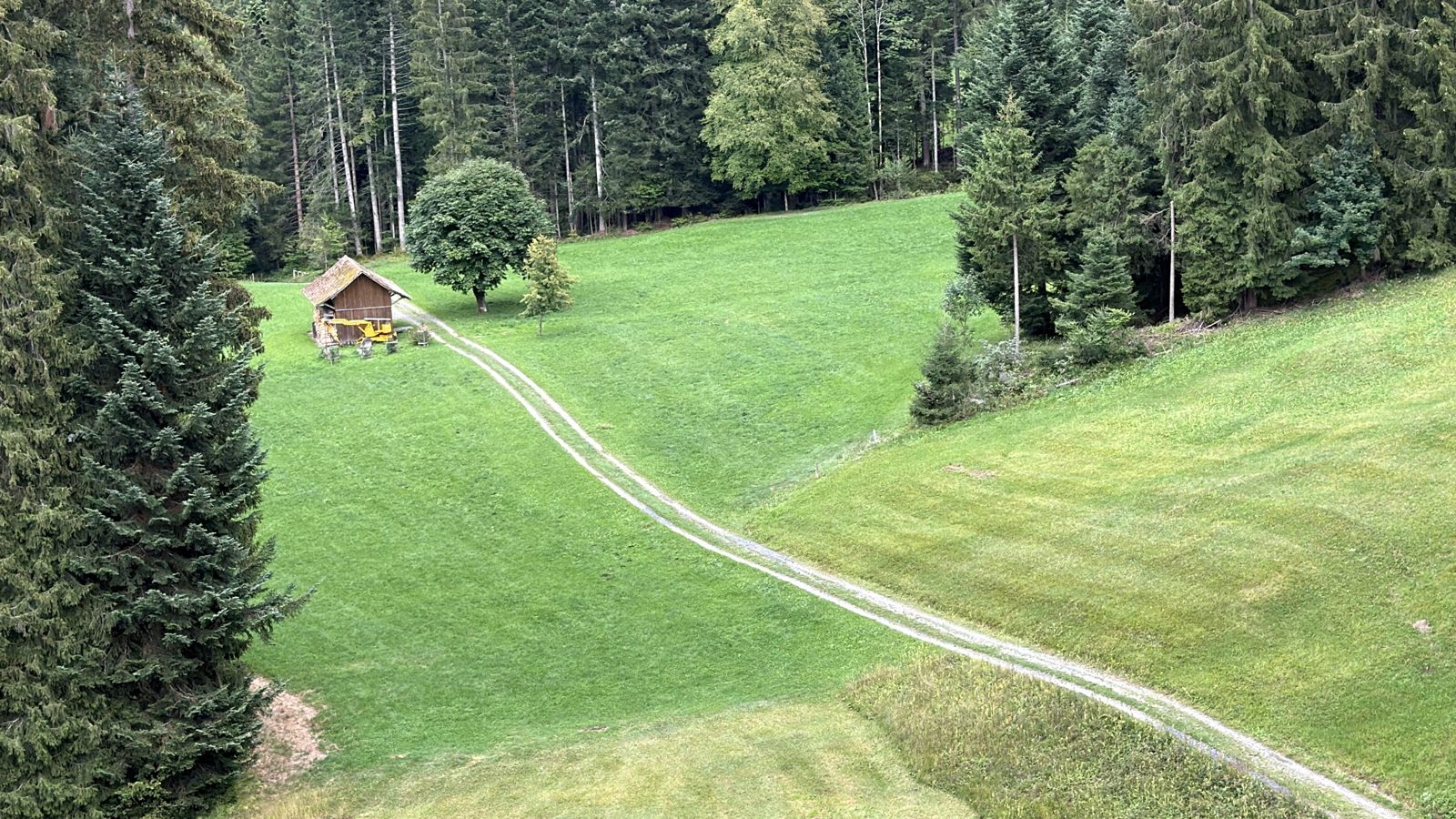 From the gondola down from Pilatus. The path is where the walking happens. The long grass and the forest edge either side are where the ticks live. Photo: RewardsGuru.club
The rest is easy to keep on a hotel trip. Long trousers on the meadow paths, a spray before the walk, and the check happens in the shower that ends every mountain day anyway.
Two things on our packing list
The repellent we chose is Murphy's Naturals Mosquito & Tick Bug Repellent Spray, 4 fl oz, pack of two. The listing says it is "30% oil of lemon eucalyptus", "EPA-registered" and "DEET-free", and claims "up to 6 hours of mosquito protection and up to 4 hours for ticks". Oil of lemon eucalyptus is on the CDC's list above, which is why we picked it over the shelf of alternatives. Four hours for ticks means a second spray at lunch on a full walking day, and the listing says to put it on exposed skin, clothing or gear rather than directly on the face. One packing note: a 4 fl oz bottle is 118 ml, over the 100 ml liquids limit for a cabin bag, so it travels in the checked bag or gets decanted.
The second thing is not about ticks. Mountain days are long walking days in the sun, and the water bottle is the thing you refill all day. We added DryWater Electrolytes + Vitamins hydration packets, mixed berry, 12 pack to the list. The listing says "zero added sugar" and a "1000 mg dose of potassium" per stick, and one stick goes into 12 to 16 oz of water. Twelve sticks covers the Swiss days with spares, and sticks are dry and flat, so they go in the cabin bag without a liquids question.
If a tick does attach
The CDC's instructions are the ones we saved to the phone. "Grasp the tick as close to the skin's surface as possible using clean fine-tipped tweezers." Then: "Pull tick away from the skin with steady, even pressure. Don't twist or jerk the tick." If the mouthparts stay behind and will not come out easily with tweezers, "leave them alone." Afterwards, "thoroughly clean the bite area and your hands with soap and water, rubbing alcohol, or hand sanitizer."
Two lines from that page matter more than the technique. "Do not wait to go to a healthcare provider to remove the tick." And: "If you develop a rash or fever within several days to weeks after removing a tick, see your doctor." The CDC adds that, depending on the type of tick and how long it was attached, a preventive course of antibiotics might help against Lyme disease, which is a conversation to have with a doctor once you are home, with the date of the bite and the place.
So a pair of fine-tipped tweezers goes in the wash bag. That is the whole kit.
This is a packing note from two travellers, not medical advice. The FOPH and CDC pages below are the authorities, and a doctor is the person to ask about the vaccine or a bite.
Useful tips
- Stay on the marked path. The FOPH says ticks live in woods with undergrowth and up to about 2,000 metres, and both agencies say to avoid the undergrowth, not the mountain.
- Cover your skin, spray an EPA-registered repellent before the walk, and check yourself in the evening shower.
- Fine-tipped tweezers in the wash bag. Pull straight and steady, clean the bite, and watch for a rash or fever for several weeks.
- The TBE vaccine is a three-injection course over months. It is a residents' decision, and a short trip cannot fit it.
- Repellent bottles over 100 ml go in the checked bag. Electrolyte sticks go anywhere.
Read on 2026-09-15: FOPH, Tick-borne encephalitis (TBE); FOPH Infectious Diseases Dashboard, Ticks and Lyme disease; FOPH, Which are the main diseases due to bacteria; CDC, About Lyme Disease, Preventing Lyme Disease, and What to Do After a Tick Bite. Product details are quoted from the Amazon listings read the same day.
Previous: Day 2 in Lucerne. Next: Day 3, Pilatus: the steepest cogwheel, and a hotel in the wrong valley.
Part of a free series. Ten days in Europe on premium credit cards, 10 daily guides and a closing ledger, with the receipts and the mistakes left in. Itineraries like this sell as $10 downloads. Ours is free because the bill is not yours to pay. The site earns from affiliate links to tools and retailers. The card links in it are personal referral links, which can earn points rather than a commission, and we run no card affiliate programme at all.
If you want the rest as it lands, follow on Threads, Instagram or TikTok. We take one thing apart properly at a time.
No names, no faces, our own photos only.
Related articles
- Day 2 in Lucerne: the 7:22 out of Paris, the Rhine Falls between two trains, and the card we had to ask for
- Day 1 in Paris: a late landing, the Arc and the tower on foot, and what the FHR night paid
- Day 0, getting there: 30,000 points, three lounges and a massage chair
- Amex Raised All Four Hilton Card Offers, and the No-Fee One Now Comes With a Free Night
Do this with your own numbers
- Purchase optimizer — run your own spending through the same numbers this article used
- Bonus tracker — today's welcome bonuses, verified on the issuer's page